Definitions
- Cash manager - someone with access to the safe
- Key holder - someone with access to the security room
- Envelope - Zipper cloth envelopes used for deposits
- Skim - when cash is pulled from the register, put in an envelope and deposited in the safe
- Skim log slip - a report that tells the cash manager what the skim is for
- Float - the fixed amount of cash in the register is at the beginning of a business day for the purpose of giving change
- Day end report - a bundle of physical papers describing all the activity in your cash register for the day
Forms
Cashier Responsibilities
- You will be assigned a key for your own till:
- Do not share your key
- Do not leave your till unattended with the key in it
- Do not leave cash laying around
- You are responsible to lock up your till after your shift
- Your float should be at $400
- You are responsible to keep adequate change in your till - do not wait until your last coin, you could get busy and need to do several sales
- You may hold extra cash in the float at your own discretion - it's sometimes handy to have a couple extra dollars to round off a total (instead of giving back 95 cents)
- Any surplus in the till should be investigated with the cash manager - did you give inadequate change? Did you forget to register payment?
- Discuss tip policy with your store manager.
Opening
- Count your till using the Opening Cash Count form. Print and sign a copy to hold for your day end report.
- Make sure you have enough change to do a typical shift:
- I suggest:
- At least 7 of $5 and $10 bills
- At least 12 of $1 and $2 coins
- At least 20 of the other coins
- If your quantities are less than that, make an exchange with a cash manager as soon as possible.
- Your opening count is a record of your change levels - your cash manager will be checking that if you frequently ask for change last minute
Skimming
- For safety, do not keep more than $1500 in your till.
- Any time you pull cash out of your till you must complete a Skim Log Slip. Print and sign 2 copies:
- Include 1 in the envelope
- Hold on to the second one for your day end report
- Give the envelope to a cash manager (or a key holder if the cash manager is not available) to be deposited directly into the safe
Closing
- Closing must be done before leaving the store, do not leave it for next morning.
- Odoo's payments report:
- Go to Accounting -> Customers -> Payments
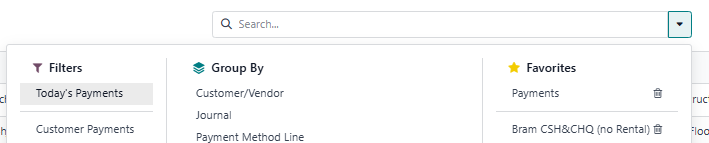
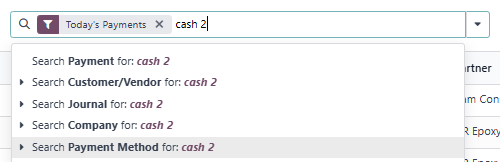
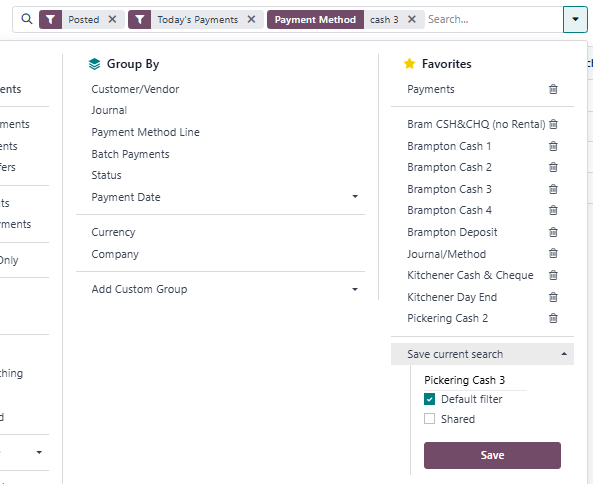
- Apply the following filters:
- 1) Date (ie. "Today's Payments")
- 2) Payment method (ie. "Cash 2")
- 3) Posted
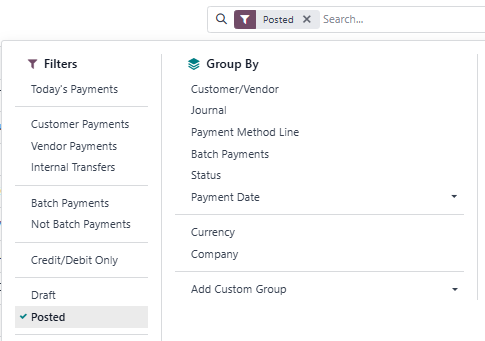
- 4) Group by Payment Date > Day:
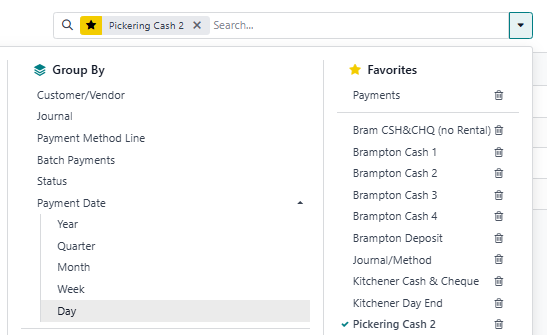
- Save to favorites (optional) to skip these steps next time:
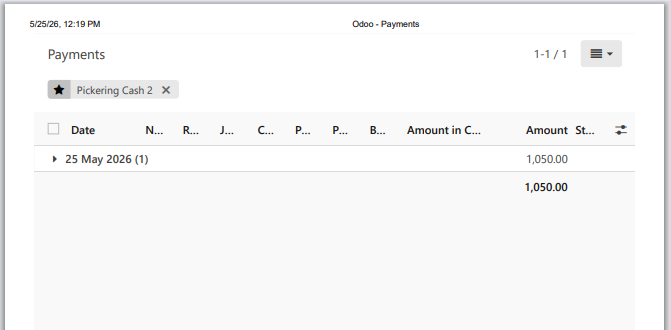
- Print this report and sign it. This is page 1 of the day end report. It should look like this:
- Add up your cash receipts to make sure it agrees with the number in Odoo. This will catch user error such as:
- Payment registered to wrong cash register
- Forgot to register payment
- Duplicate payments
- Do a final skim:
- The total of your skims for the day must match Odoo's amount within $0.02 (penny rounding).
- Cash shortages/surplus should affect your float, not your final skim.
- Count your till using the Closing Cash Count form. Print a copy for your day end.
- Day end report should include the following in this order:
- Odoo's payments report
- Skim log slip(s)
- Opening cash count
- Closing cash count
- All cash receipts from sales for your cash register
- Staple the day end report together and leave on your cash register for a cash manager to collect.
Cash Manager's Duties
- Day end reports will be checked for accuracy, completion and formatting:
- Is all information filled out?
- Are all forms signed?
- Are skim log slips included with envelopes?
- Does the total of skims equate to the amount shown in Odoo within $0.02?
- Is there a discrepancy between the sum of the cash receipts and the amount on the Odoo payments report?
- Envelopes will be counted and compared with the skim log slips
- Any missing reports, shortages or discrepancies will be discussed with the cashier - repeated inaccuracies will result in disciplinary action since proper cash handling is an essential component of your role as counter salesperson.
- Other daily duties:
- Prepare a cash deposit when cash on hand exceeds a certain threshold
- Ensure enough change is on hand for a few days